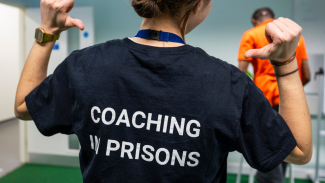
Could prison gym staff hold a key to rehabilitation? This was the question we set out to explore with a small and innovative pilot programme delivered at HMP Brixton in 2024, training prison gym staff directly with coaching skills.
Today, we’re pleased to publish a new evaluation report of this work, authored by Dr Rosie Meek of Royal Holloway University of London, which recommends the programme could be expanded across the Prison Service to support staff retention and reduce reoffending.
READ THE REPORT HERE
We know that prison staff at all levels play a vital role in making prisons safer places that support people to change their lives for the better. This report emphasises the evidence showing interpersonal relationships and individual interactions are key to effective desistance and creating calmer prison environments – all of which HM Prison and Probation Service have stated are urgent priorities.
We chose to focus on training gym Physical Education staff because they hold a ‘wealth of social capital’, spending a significant amount of time directly interacting with prisoners in their care. This made it more likely the people they engaged with would be open to meaningful conversations, supporting them to reflect on their goals and future.
The training equipped participants with the ability to listen for feelings and values, ask quality coaching questions, and in turn build increasingly beneficial and impactful relationships with the people in their care. All participants were hugely positive about the training, with one suggesting: “The Prison Service should introduce elements of it in all staff training, it’s a people job and you deal with people whether as staff or prisoners.”
They reported the training had supported their collaboration with prison service colleagues, their personal decision-making, and their own wellbeing, sharing: “We’ve been utilising it every day.”
The training was seen as having impact beyond just the gym whilst engaging some of the people with more complex needs and behaviours held within the prison: “It’s been instrumental in working with people who are usually very difficult, it works really well, I use it all the time.”
Vicki Cardwell, CEO of Spark Inside said:
“We’re really excited by the promise of this innovative pilot. Prison gyms are often described as the ‘heart’ of any prison, providing much-needed space for prisoners to socialise whilst supporting their health and wellbeing.
This evaluation shows that equipping gym staff, who interact regularly and positively with prisoners in their care, with coaching skills not only uplifts their personal capacity but has impact that ripples outwards, improving collaboration with colleagues and staff’s own wellbeing.
This is an intervention that can be quickly scaled, without requiring new space or staff; it works to support and expand pre-existing resources which is critical within our over-stretched prison system. Our hope is that we will now have the opportunity to expand on this pilot, bringing these incredibly useful skills to more prison staff, and continue to evidence the impact this training can have on the culture of our prisons.”
Mia Wheeler, Governor of HMP Brixton shared:
“The PE department has a broad remit across the entire prison, working to improve the health and wellbeing of our prisoners and staff.
The team have embraced the opportunity to complete the coaching skills training and have commented they have been able to see prisoners change their mindset and perspective of certain situations to achieve more balance and respond with more acceptable social outcomes.
The impact we have already seen also demonstrates the potential to extend coaching skills more widely across our front-line staff. Building confidence and capability in reflective conversations, problem-solving and constructive challenge could strengthen the consistency of day-to-day delivery, support more positive staff-prisoner relationships and help colleagues intervene earlier and more effectively.
There is a real opportunity to explore how a broader coaching approach could support sustained improvements in practice across the prison and our ability to improve outcomes for individuals and the wider prison environment.”